Oval date stamps produced for Cue.
- Australia 1901-1988
- New South Wales
- Overview of NSW
- Telegraph lines
- Telegraph Offices
- Date stamps
- Forms
- Envelopes
- Instructional annotation
- Collect
- Delayed
- Free
- Immediate Urgent
- Reply paid
- Rates
- Stamps
- 1871 Telegraph stamps
- 1885 proposal
- 1893 proposal
Other listings of Cue oval date stamps list three formats. The formats were RO2, RO6 and RO7. The following analysis extends these previous classifications to eight distinct types. There were two different inscriptions at the top - either TELEGRAPH OFFICE or POST AND TELEGRAPH OFFICE (with variations). There were also the three different formats for the ovals.
Information which extends any of the statements is most welcome. An overview of date stamp classification and a description of eccentricity to measure their shape is provided elsewhere.
The Cue Telegraph Office opened in November 1894.
The date stamps are arranged below in order of complexity of design and then
by TELEGRAPH OFFICE and then POST & TELEGRAPH OFFICE.
- Two outer rings only (RO2) - both TO and P&TO;
- Inner ring is a continuous line (RO6) - TO P and TO, P & TO.
- Inner ring is a scalloped line (RO7) - TO and P & TO.
Click on the following hyperlink for details of the Australian classification scheme for Telegraph date stamps.
| RO2 - TO.
There are two formats for this type - distinguished by the eccentricity of the oval - the lower the value, the more circular. |
|
|
|
|
 13 October 1947. In violet. |
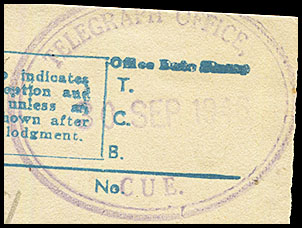
| RO2 - P & TO.
Post & Telegraph Office.
|
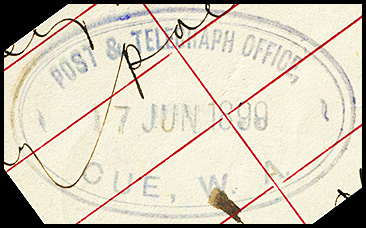 17 June 1899. In blue. See rare use of this format and together with format RO7-TO on the same delivery form. |
|
| Although few examples of this format are recorded, all have an overinked C or the letter had not been cut correctly. |  24 November 1900. In blue. |
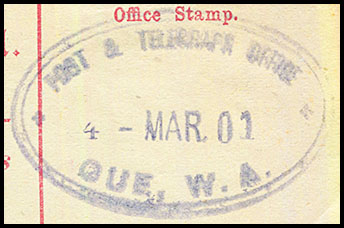 4 March 1901. in violet. |
| RO6 - TO.
Has stars for separation between upper and lower inscriptions. |
|
Used: 28 November 1894 to 4 December 1897; Many of these date stamps are very light and the 9 is missing in many of the year entries. See the use on the two special W.A. INTERNATIONAL forms. |
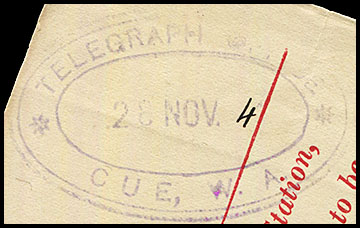 Telegraph Office. 28 November 1894. Used on WC-DO-4Ca. |
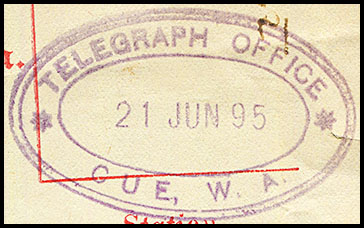 21 June 1895. Telegraph Offive in violet. On piece. |
 10 September 1895. Telegraph Office in violet. Used on WC-DO-4Ca. |
| RO6 - P and TO.
Has "AND" after POST and no space after "W.". |
||
Used in blue: |
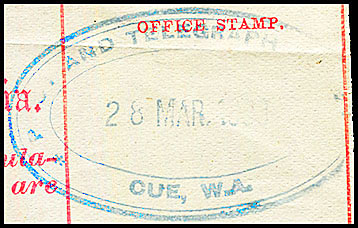 Post and Telegraph Office - in blue. 28 March 1899. |
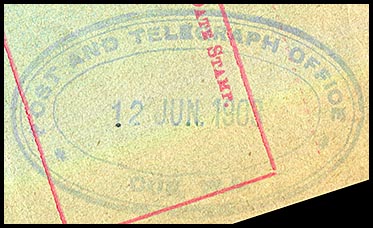 Post and Telegraph Office - in blue.
12 June 1903. Used on the rare Urgent Telegram delivery form ( WC-DU-1). |
|
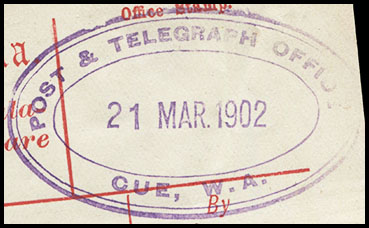 21 March 1902. Post & Telegraph Office in violet. Used on WC-DO-5B. |
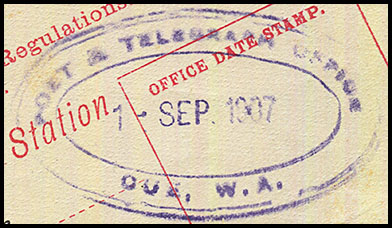 1 September 1907. Post & Telegraph Office in violet. Used on WI-DO-2A. |
| RO7 - TO.
Has separations rosettes between upper and lower inscriptions. |
|
See a rare use of both this format and format RO2-P&TO on the same delivery form. |
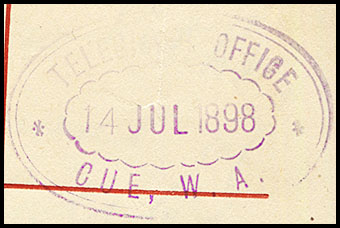 14 July 1898. Telegraph Offoce in violet. Used on WC-DO-4C. |
 29 October 1898. Telegraph Office in violet. On piece. |
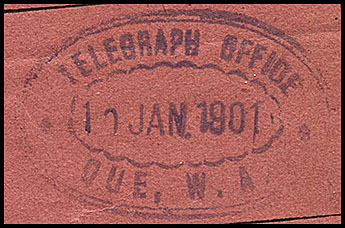 Telegraph Office in violet. 10 January 1901. |
| Some examples - especially the later ones, the C of CUE has no gap. | |
|
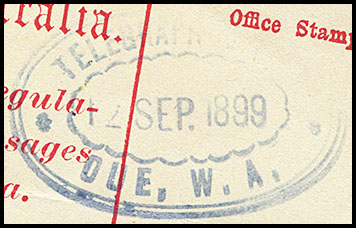 12 September 1899. Telegraph Office in blue. Used on WC-DO-5A. |
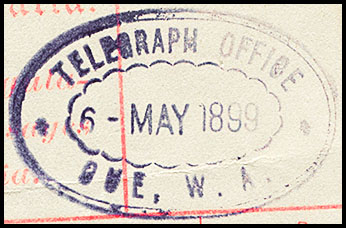
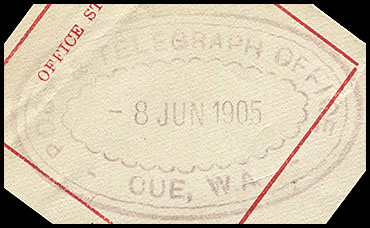
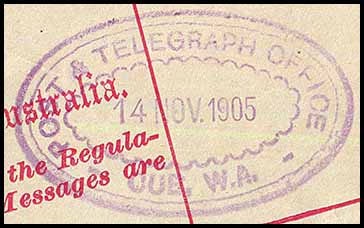
| RO7 - P & TO. Post & Telegraph Office in top border confined above horizontal diameter. |
||
Type 1: Rosettes used to separate the two inscriptions are placed approximately on the horizontal between the 2nd and 3rd lines.
|
||
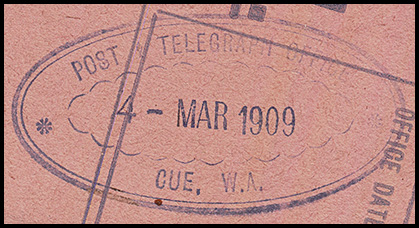 4 March 1909. Used on WI-DO-2Ba. Earliest recorded date. |
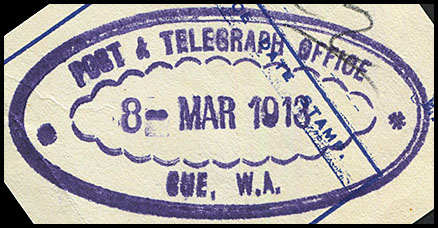
8 March 1913. Note in both of these date stamps, the small splits in the both ends of the inner scalloped ellipse. |
|
 12 January 1912. Oval used in violet on a piece cut from an urgent rate telegram. Note the small split in the LHS of the inner scalloped ellipse is the same in both. |
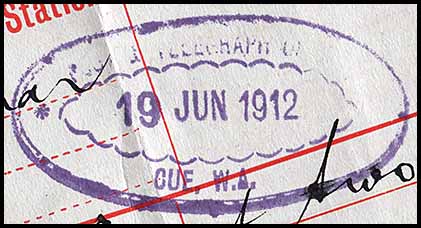
19 June 1912. Note the small split in the LHS of the inner scalloped ellipse is the same in both. Used on WI-DO-3B. |
|
| Type 2: Rosettes used to separate the two inscriptions are placed well below the horizontal between the 2nd and 3rd lines. | ||
|
||
 21 March 1907. |
 16 September 1912 - in violet. |
|
| RO7 - P & TO. Post & Telegraph Office in top border confined above horizontal diameter - the same as for the previous entry. For these date stamps, the inside scalloped design is only partially seen. |
||
|
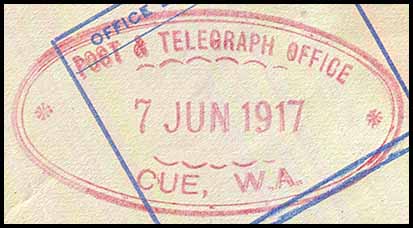 7 June 1917. Used on WI-DO-5Cb. |
|
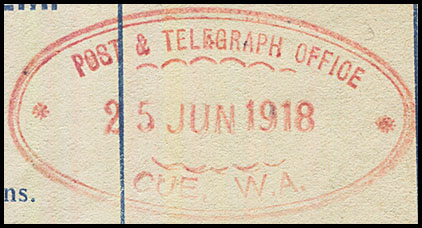 25 June 1918. |
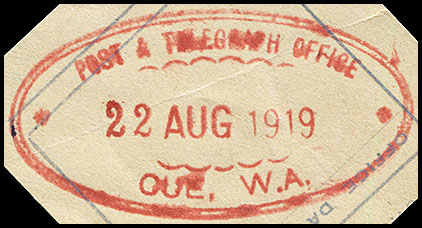 22 August 1919. Overinking on C of Cue. |
|
Has small vertical dash separation marks at either end of the outer ring.
|
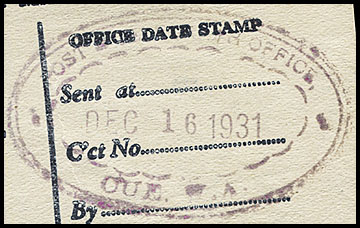 16 December 1931. Used on Commonwealth delivery form AB-DO-6A. |