Overview of ordinary rate transmission forms.
- Australia 1901-1988
- New South Wales
- Queensland
- South Australia
- Tasmania
- Victoria
- Western Australia
- International
- Special aspects
There were 11 types of transmission form issued by New South Wales in the Colonial period to 1900. The first eight formats incorporated the words "Electric Telegraph" in the heading. The remaining three formats, issued in 1894, incorporated the words "Post and Telegraph".
Most headings were curved - the extent of the curve varying from slightly to deeply curved. These can be easily distinguished as follows:
- shallow curve - a line joining ends of the heading (i.e. N to H.) touches the bottom of the Coat of Arms. The distance from the bottom of the point under the Coat of Arms to the top ot the middle T in TRANSMITTED is 24 mm.
- deeply curved - a line joining ends of the heading (i.e. N to H.) passes about 2 mm underneath the Coat of Arms. The distance from the bottom of the Coat of Arms to the top ot the middle T in TRANSMITTED is 30 mm.
The early formats are very rare.
There was no urgent rate forms in the Colonial period.
In the Legislative Council of 22 June 1876, Mr. Docker, replying to a question answered "that it had been decided to order the issue of fresh forms for telegraphic messages, showing the time at which each message was received for transmission and the time at which it was issued for delivery. An order had been given not lo print any more of the forms now in use, in order that the new forms might be brought into use as soon as possible".
| NC-TO-1. | Straight line heading in serif Roman font with "New South Wales" on one side of the 20 mm Coat of Arms and "Electric Telegraph" on the other.
Has MESSAGE FORM in top left corner. Above blank message area are two unboxed sections for Sender details (on left) and Recipient details (on right). Printed in black on blue paper. |
|
| NC-TO-2.
|
Slightly curved heading printed in Old London font above the 25 mm Coat of Arms.
Has MESSAGE FORM in top left corner. Message area on front is blank. Printed in black on blue paper. |
 |
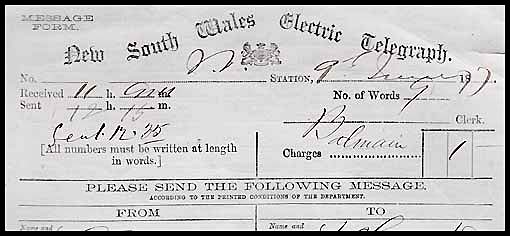
| NC-TO-3. | Slightly curved heading is printed above the 15 mm Coat of Arms in Old London font.
Has MESSAGE FORM in top left corner. Message area on front is boxed and numbered on left to 45. Reverse side is boxed and numbered to 135. |
 |
| NC-TO-4. | TRANSMITTED FORM in non-serif type as top line which was then standard for all subsequent forms.
Straight line "...ELECTRIC TELEGRAPH" heading in serif Roman font. Sub-heading is Printed in orange-red on blue paper. |
|
| NC-TO-5. | Slightly curved "...ELECTRIC TELEGRAPH" heading in Old London font. Coat of Arms is 14 mm wide.
Printed in black on blue paper. Boxes for message on front and reverse. Regulations and (on some forms) Charges appear on all but one format. |
|
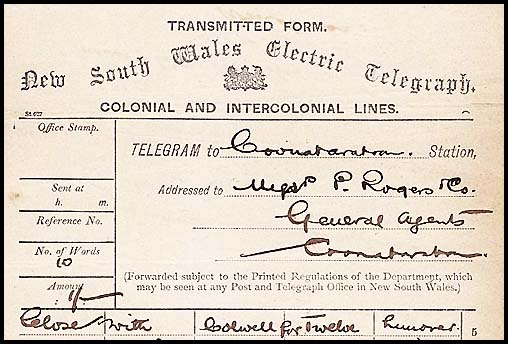
| NC-TO-6. | Slightly curved "...ELECTRIC TELEGRAPH" heading in Old London font. Coat of Arms is 14 mm wide.
Printed in black on white paper and slightly smaller than TO-5. Boxes for message on front and reverse. |
 |
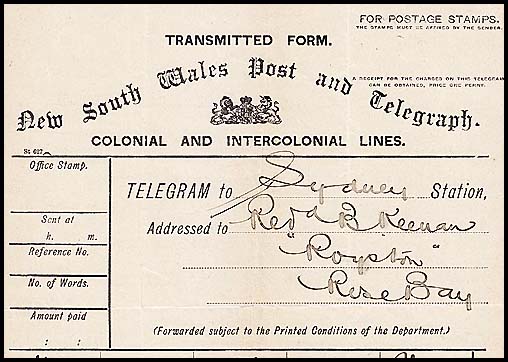
| NC-TO-7. | Slightly or deeply curved "...POST AND TELEGRAPH" heading in Old London font.
Printed in black on white paper. Boxes for message on front (numbered to 35) and on reverse. The early (1880s) printings also have CHARGES and REGULATIONS on the reverse. |
 |
| NC-TO-8. | Same format as type 7 but with a 6d rose printed stamp image. | 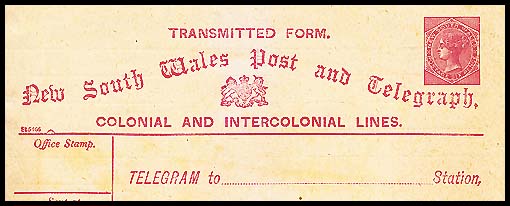 |
| NC-TO-9. | Same format as type 7 but with a 1/- black printed stamp image. | 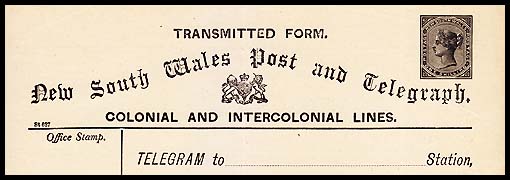 |