Overview of telegraph stationery.
- Australia 1901-1988
- New South Wales
- Queensland
- South Australia
- Tasmania
- Victoria
- Western Australia
- International
- Special aspects
The South Australian telegraph stationery can be accessed through the hyperlinks below. The delivery forms are organised within the two periods of administration.
- transmission forms;
- delivery forms - Magnetic Telegraph period;
- delivery forms - Electric Telegraph period;
- envelopes;
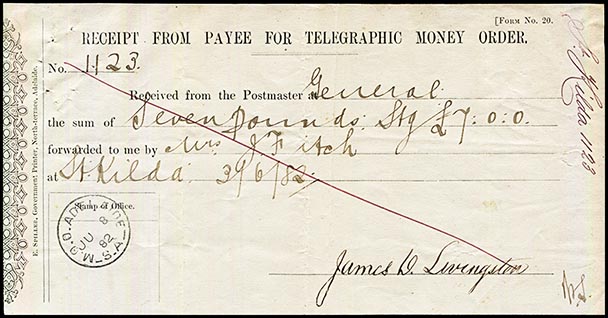
- Money Orders.
South Australia introduced a system of Urgent Rate telegrams for which users had to pay double the normal rate in the 1890s but no records can be found.
Only one transmission form for South Australia issued during the Colonial period can be located. Such forms did however exist as is reflected in the following letter to the Editor of the South Australian Register of 22 May 1873:
Sir — There being but little difference in the various forms used by the Telegraph Department in sending and delivering messages, would it not be as well, in order to prevent fictitious telegrams being manufactured, that every message sent from the office should be stamped with the date in some such way that letters are.
I am, Sir, &c, PRECAUTION.
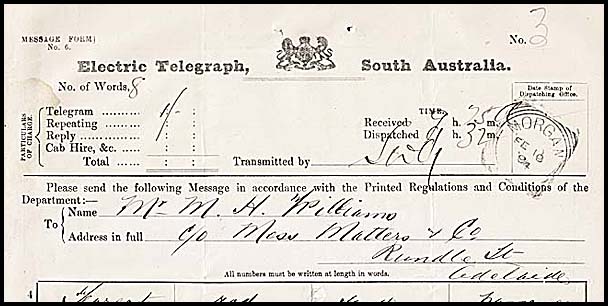
| SC-TO-3.
Has MESSAGE FORM in the top left corner. Has boxes for a 20 word message on the front and up to 88 words on the reverse. |
 |
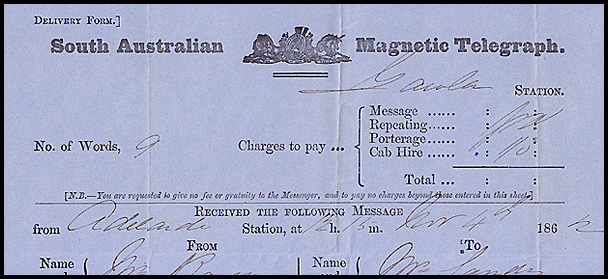
| SC-DO-1.
Form printed in blue. Has DELIVERY FORM in the top left corner. Large heading area in two distinct sections with a line in between.
|
 |
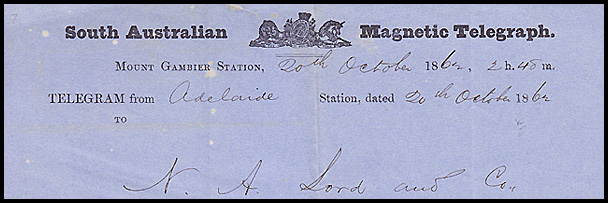
| SC-DO-2.
Form printed in blue. Very long form with only a four line heading.
|
 |
One number has not been used - another form must have been produced over the 15 year period.
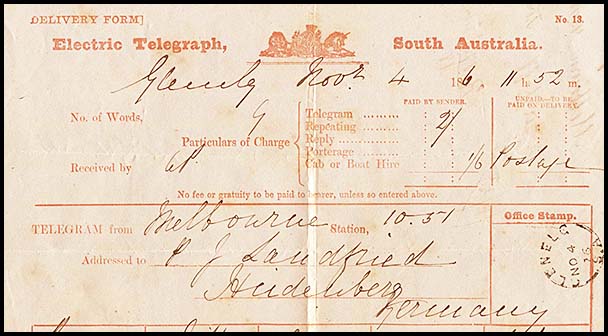
| SC-DO-4.
Prominent DELIVERY FORM in top left corner and No 13 in top right corner. Two information sections above the message boxes which are arranged with five boxes per row. Reverse side is blank. |
 |
| SC-DO-5.
Prominent DELIVERY FORM in top left corner and No 13 in top right corner. Has name of Receiving Station printed in bold. Two information sections above the message boxes which are arranged with five boxes per row. Reverse side is blank. |
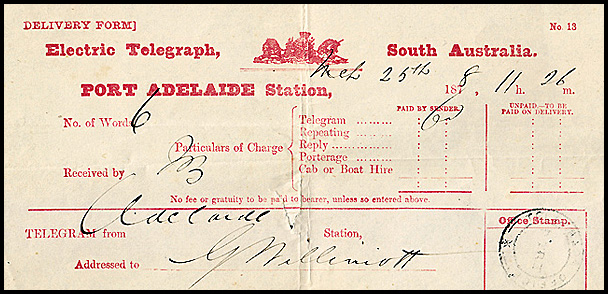 |
| SC-DO-6.
Has small DELIVERY FORM in top left corner and No 13 in top right corner. Two information sections above 20 message boxes . Second section has "Dated ..." and "Time handed in ...". Reverse side has 68 boxes in 17 lines allowing for a message of up to 88 words |
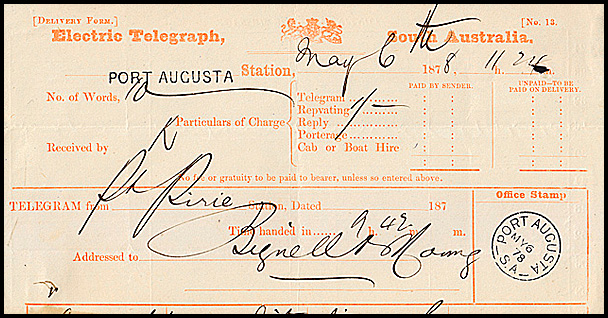 |
| SC-DO-7.
Has small DELIVERY FORM in top left corner and No 13 in top right corner. Two information sections above 20 message boxes. Second section does NOT have "Dated ..." and "Time handed in ...". Reverse side has 68 boxes in 17 lines allowing for a message of up to 88 words |
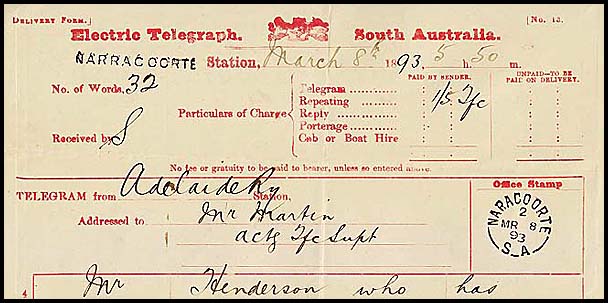 |
| SC-DO-8.
No longer has No. 13 in top right corner. All details are in one section above the message boxes. There are 32 boxes in 8 rows of four columns on the front. Some forms of Type 8 have the station name printed. |
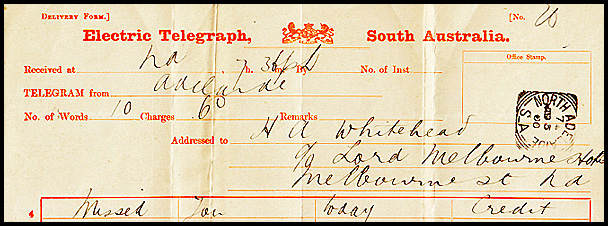 |
Telegraphic Money Order
| No forms are known for the Colonial period.
This link goes to the receipt plus information about the creation and operation of the Telegraphic Money Order system in Colonial South Australia. |
 |