In Memory of those who served.
- Australia 1901-1988
- New South Wales
- Queensland
- South Australia
- Tasmania
- Victoria
- Western Australia
- International
- Special aspects
Notification of the death of service personnel.
The two World Wars touched many thousands of Australian families. In the Great War, about 60,000 Australians had died. About 39,000 died in World War Two.
One of the difficult questions for the Governments that arose was how the news of servicemen’s deaths should be broken to their families. This was a real problem:
- should the local clergyman (who in those days was much more a part of the community than is the case today) deliver the news;
- should the news come via the telegram boy.
The churches felt that their ministers were best equipped, by training and experience, to perform this task.
Eventually there was a compromise under which local committees of clergy and postmasters decided how the telegrams were to be delivered in their areas. Even this led to confusion, and in the end Arthur Fadden, as Acting Prime Minister, announced that all telegrams would be delivered by telegram boys. That is what happened until the war ended and all such terrible messages had been delivered.
In World War 1, the forms used to inform families of a death were just the standard urgent rate forms. In 1942, a special form was printed explicitly for notification of death. The use of this special form was continued into the Korean conflict.
The following examples show the feared news was received by far too many families during these three conflicts in which Australian forces served.
The telegrams represent:
| At present neither media is connected.
Click one of the media buttons (make sure your audio is on). |

|
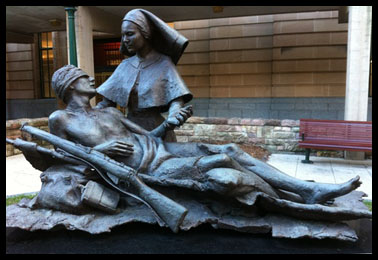
|
|
(And the band played Waltzing Matilda John Williamson - 1.5 minute extract). |
(A Pittance of Time. Terry Kelly - 1.5 minute extract). |
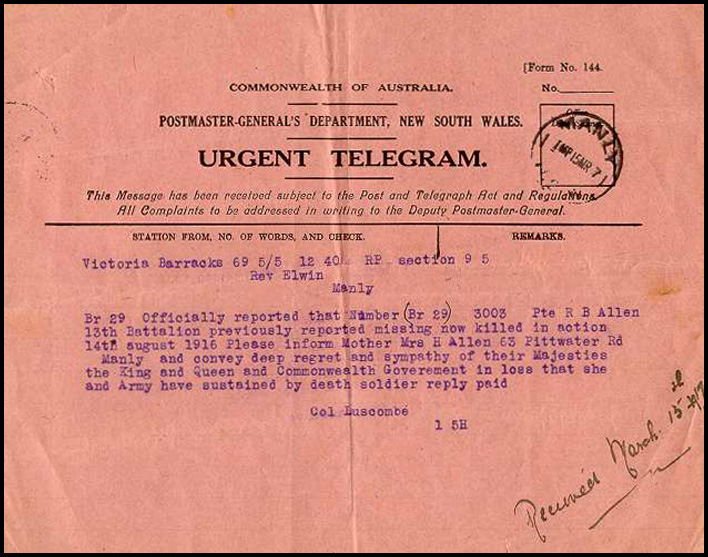 |
NI-DU-6A.
Victoria Barracks to Manly Confirmation that Private R. B. Allen of the 13th Battalion had been killed in action. |
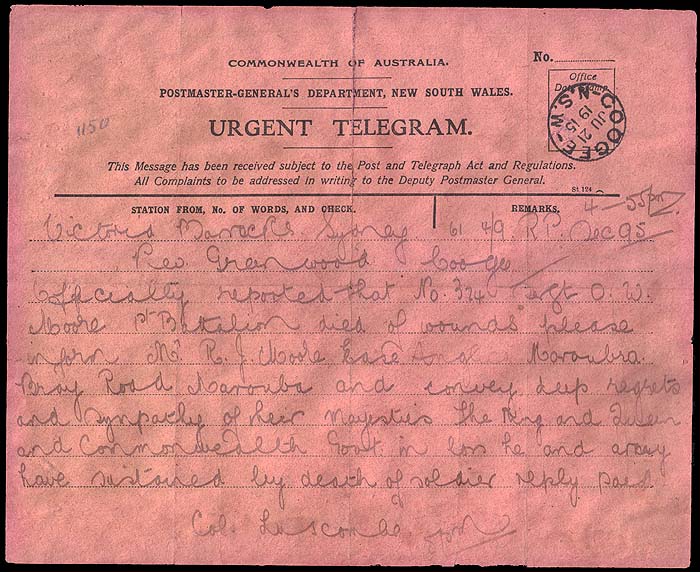 |
NI-DU-6C.
Victoria Barracks, Sydney to Coogee, NSW (21 July 1915). Urgent telegram requesting Rev. Greenwood to notify the father of Sergeant Oswald Walter Moore of his son's death. Sergeant Moore (324) was a member of the 1st Battalion, C Company Australian Infantry, A.I.F. He had enlisted at Sydney, New South Wales. Sergeant Moore was the son of Sarah Lydia Moore of "East Anglia", Maroubra Bay Rd, South Randwick, NSW He was born in Dunedin, Otago, New Zealand. |
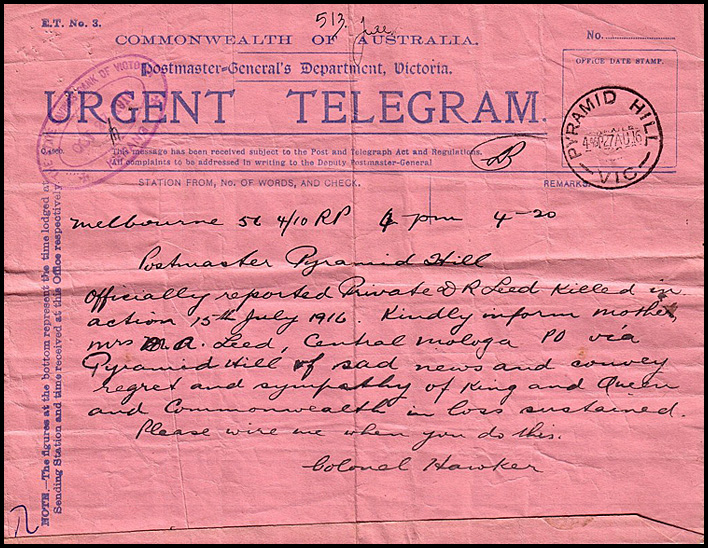 |
VI-DU-B2a. Melbourne to Pyramid Hill. 27 August 1916. Request to the Postmaster to visit the mother of Private D. R. Leed to confirm he had been killed in action. |
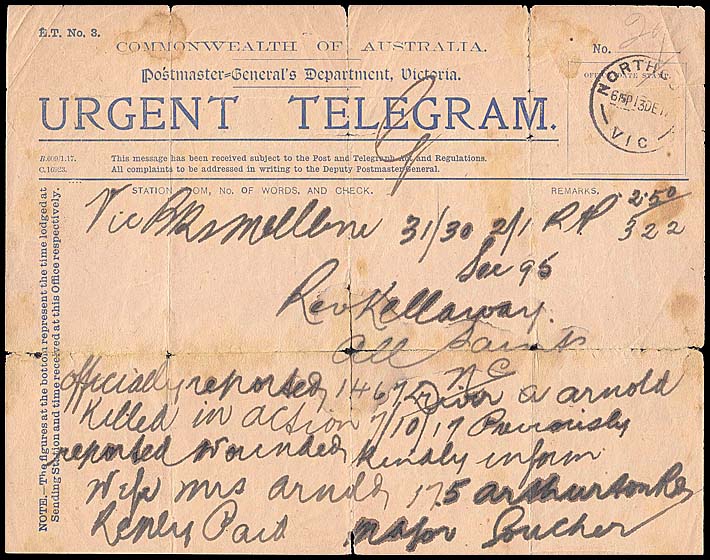 |
VI-DU-2Bb.
Victoria Barracks, Melbourne to Northcote. Urgent telegram requesting Rev. Kellaway to notify the wife of Alfred Arnold of the 4th Brigade, Australian Field Artillery of his death in October 1917. |
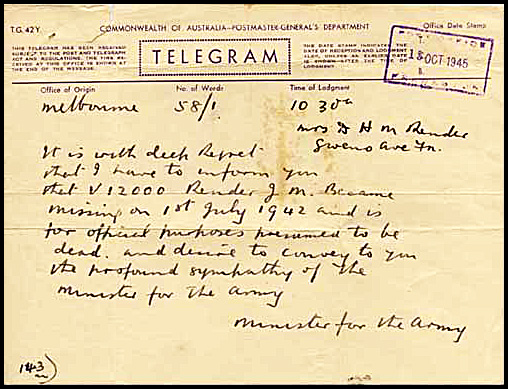 |
Melbourne to ? 15 October 1945. Telegram to Mrs Render informing her that her husband or son (possibly) had been missing in action since 1 July 1942 and was now presumed dead. |
See also:
|
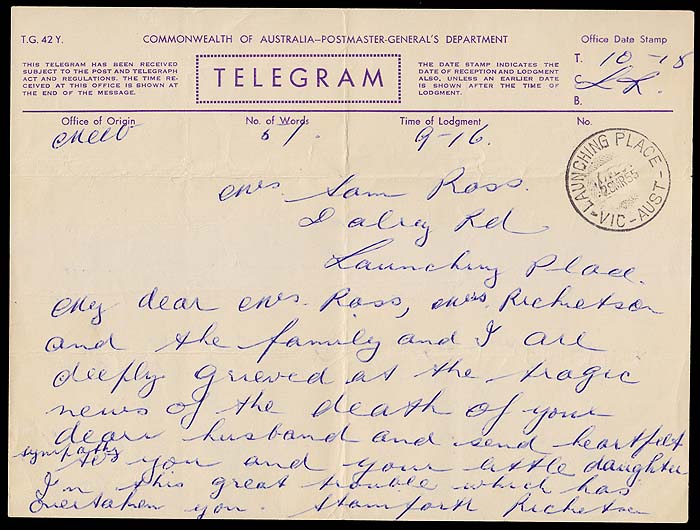 |
Melbourne to Launching Place, Vic. 28 March 1955. Telegram from friends using the special Fatal Casualty form. Sam Ross was killed during the Korean conflict. |
An advertisement in Australian newspapers described the family context of such telegrams in the most direct and personal way.
HINT: After reading, use the BACK button ((top left of screen) to return to this site.