South Australia - Interim period: 1901-1917.
Urgent rate delivery form: SI-DU-2.
Queensland
South Australia
Tasmania
Victoria
Western Australia
International
Special aspects
Urgent rate delivery form: SI-DU-2.
- Australia 1901-1988
- New South Wales
- Overview of NSW
- Telegraph lines
- Telegraph Offices
- Date stamps
- Forms
- Envelopes
- Instructional annotation
- Collect
- Delayed
- Free
- Immediate Urgent
- Reply paid
- Rates
- Rates
- Summary of Telegram rates 1858-1900.
- NSW - Qld rates 1858 to 1870
- NSW - Vic rates 1858 to 1870
- Stamps
- 1871 Telegraph stamps
- 1885 proposal
- 1893 proposal
General characteristics:
| Heading and notes: | Form number E. T. No. 3. Standard Interim heading. |
| Message area: | Blank. |
| Reverse side: | Blank. |
| Colours (text & form): | Black on salmon coloured paper. |
| Size of form overall: | 192 × 224 mm. |
| Size of datestamp box: | 34 × 33 mm. |
Distinctive characteristics of the form:
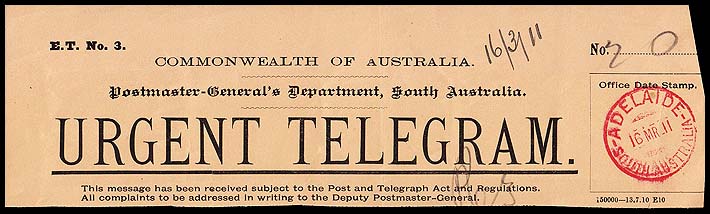
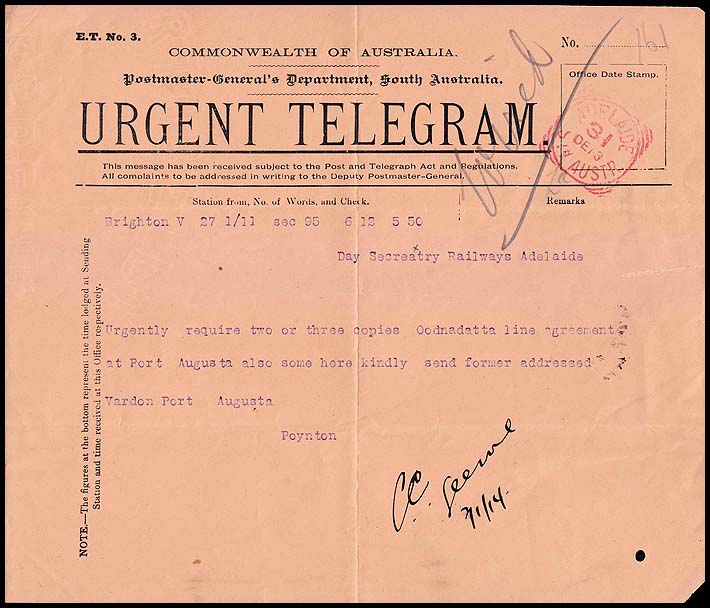
Details of use and rarity.
| Form sub-number |
Schedule number | Earliest recorded date | Rarity rating |
| DU-2B | 150000 - 13.7.10 E10 | 16 March 1911 at Adelaide. | RR |
| DU-2C | None | 31 December 1913 at Adelaide. | RR |